- Boots-commissioned report with Public First finds expanding healthcare services on the high street could not only revitalise communities, but save millions of missed working days and 14.6 million GP appointments
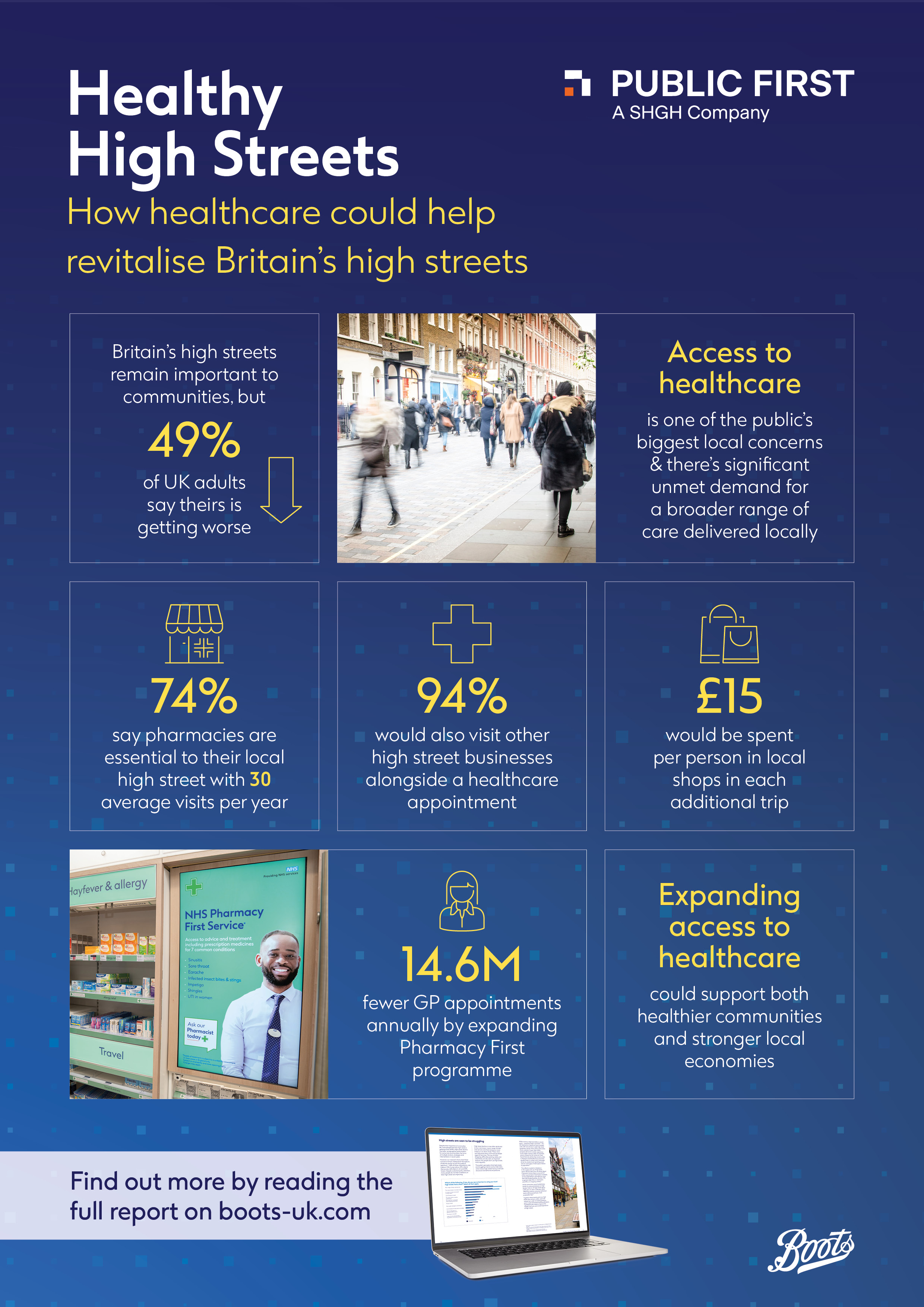
- Healthcare access and decline of high streets rank among the public’s top concerns – 49% of UK adults say their local high street is getting worse, with access to healthcare the second most important local issue
- £13 billion economic boost to high streets could be unlocked as 94% would visit other shops on the high street alongside a healthcare visit
- 74% say pharmacies are essential to their local high street – rising to 81% among those aged 65 and over
Boots, the UK’s leading health, wellness and beauty retailer, today publishes research showing that expanded healthcare provision on the high street could deliver a £13 billion boost to the UK economy and reduce pressure on the NHS.
The Healthy High Streets report, produced with Public First, finds that 94% of UK adults would visit other shops and businesses if more healthcare services were available on their local high street, with an average additional spend of £15 per trip. Services the public ranked as being important included dental services (77%), vaccinations (71%), testing and diagnostics (72%), eye care (75%), managing long-term conditions like diabetes and high blood pressure (71%), and weight loss management (54%).
With the Government developing its High Streets Strategy and the NHS 10 Year Plan committed to shifting care into communities, Boots is calling on policymakers to put healthcare at the heart of high street renewal.
UK high streets remain resilient and continue to be at the heart of local communities; 88% of people said that the local high street is very important or important to overall quality of life. High streets give people a sense of belonging, but they have faced significant pressure in recent years from the rise of online shopping and increased costs to anti-social behaviour and retail crime. The average city centre has a high street vacancy rate of 13%2, while high street footfall is in general decline, falling by 6.2% in the five weeks to July 5 year-on-year.3 Nearly half of UK adults (49%) say their local high street is getting worse, and the public is clear that action is needed.
In parallel, healthcare services are under strain. 30% of people in the UK view access to healthcare as an important issue facing their local area, second only to access to affordable housing. The data is striking, with 57% of people saying they would use health screenings more often if services were more accessible locally, and 77% saying that the distance to their nearest provider has a moderate to significant impact on their overall health.
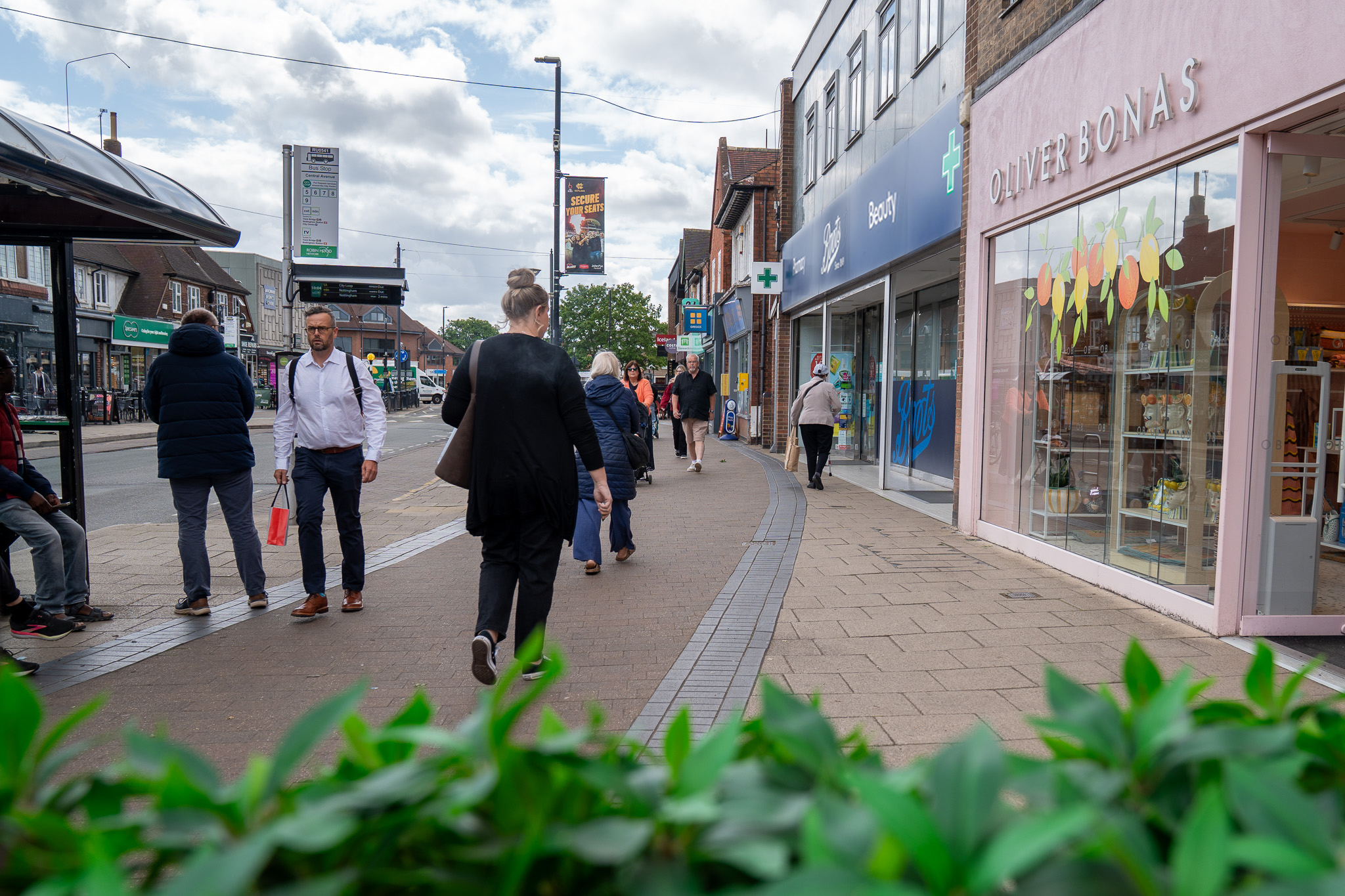
The benefits continue in the potential to support the NHS. Pharmacists are trusted healthcare professionals and pharmacies are the fourth most visited location on the high street, with 74% of people describing them as essential. That trust creates a significant opportunity. Expanding community pharmacy provision would reduce pressure on primary care, supporting the NHS's own ambition to shift more care into community settings. An expansion of the services provided by Pharmacy First, for example, would lead to 14.6 million fewer GP appointments, reducing strain on the NHS and improving patient outcomes.
Where projects have successfully brought healthcare to the high street, it has a proven impact. In Barnsley, a former Wilko store in the Alhambra Shopping Centre was repurposed into an NHS health and wellbeing hub. It generated 50,000 additional high street visits per year, demonstrating the tangible footfall benefits and significant multiplier effect healthcare-led regeneration can deliver.
Health Minister Stephen Kinnock, said: “The government’s 10 Year Health Plan is centred on bringing more care closer to home, into the heart of communities across the country where people live and work – and this research shows that’s exactly what the public wants.
“When people need to travel too far or take time off work or take their children out of school for appointments it affects their day-to-day lives and impacts productivity, efficiency and the economy.
“By making best use of our high street optometrists and pharmacists and rolling out Neighbourhood Health Centres, we will ease pressure on GPs, improve patient outcomes, while breathing new life into communities and boosting the economy.”
Seb Wride, Head of Research at Public First, said: "The public want more healthcare on their high street, but the gap between what people expect and the reality on the ground, tracks closely with a sense that local areas are falling behind. This research shows how significant this is, with the same people who are dissatisfied with local healthcare provision saying their high street is in decline.
“When we talk about high street renewal, we often focus on the shops and cafes that might be expected to drive footfall, but this research surfaces the importance of the essentials too. When the public talks about what they need on their high street, they highlight critical services like healthcare. This is what a healthy high street means to the public.
“The local pharmacy sits between two key political issues. Public concern about the decline of their high street, and the challenge with accessing healthcare. This means that pharmacies can help solve two problems in one, providing convenient access to in-person healthcare services, and bringing more shoppers back to the high street and boosting the local economy."
Ruth Rankine, Director of Primary, Community and Neighbourhood Health at The NHS Alliance, said: “These findings highlight just how highly the public value access to a broad range of healthcare services on the high street.
“In addition to improving the health of local communities and helping to tackle health inequalities, access to local healthcare services — including general practice, dentistry, optometry and community pharmacy — can deliver wider social and economic benefits and increase footfall in town centres.
“We believe that the Primary Care Collaboratives emerging across the country provide an ideal vehicle for working with commissioners and local authorities to strengthen the health offer on high streets, while ensuring neighbourhood health services take a broader approach to prevention and the social determinants of health through close partnership with public health teams.
“If we are to realise the ambition set out in the Ten-Year Health Plan to shift care closer to home, local authorities will have a vital role in embedding ‘health on the high street’ principles. Success will also depend on strong collaboration between councils, the NHS, the voluntary and private sectors, and local communities.”
Anthony Hemmerdinger, Senior Vice President & Managing Director, Boots, said: “People are increasingly looking for convenient, accessible healthcare services in the heart of their communities, and high street pharmacies are uniquely placed to meet that need. This report highlights a significant opportunity to improve public health, ease pressure on wider NHS services and bring more people back to local high streets. As the Government develops its High Streets strategy and delivers the NHS 10 Year Plan, there is a real opportunity to unlock the full potential of community pharmacy. Boots has been serving communities for over 175 years, and our pharmacy teams are trusted by millions of patients every day. We stand ready to work in partnership to help deliver better access to care, support healthier communities and contribute to thriving local high streets for the future.”
Janet Morrison OBE, Chief Executive of Community Pharmacy England, said: “Community pharmacies are the most accessible part of the NHS, offering a range of high-quality clinical services and healthcare advice for patients and the public on a walk-in basis. Their convenient locations on high streets across the country not only support easy access to healthcare, but also put pharmacies at the heart of efforts to improve local economies. Pharmacies are popular with the public, important as local employers and provide a vital support structure for the wider NHS, while also bringing life to fading high streets. As this report confirms, expanding the healthcare offer from pharmacies would go far beyond improving for health outcomes, bringing wider benefits for high streets, productivity and the public.”
Helen Dickinson, Chief Executive of the British Retail Consortium, said: "High streets sit at the heart of our communities. They are places to shop, eat, meet friends, and access essential services. Pharmacies and healthcare providers are a vital part of thriving town and city centres, helping to deliver better outcomes for our communities. A successful high street depends on a strong mix of retail, hospitality and essential services, supporting jobs, growth and local investment. Government can help unlock that potential by tackling crime, creating a more effective planning system and reducing the burden of business rates. This would give businesses the confidence to invest, strengthen the vibrancy of town centres and ensure high streets continue to serve the communities that depend on them."
1 Public First conducted an anonymous, online survey of 2,015 adults across the UK from 16th - 30th January 2026. All results are weighted using iterative proportional fitting, or ‘raking’. Results are weighted by interlocking age and gender, region, and social grade to nationally representative proportions.
2 Checking out: The varying performance of high streets across the country | Centre for Cities
3 BRC-Springboard footfall monitor